


How to Create the Perfect Itinerary In Pakistan?
Have you noticed how some travelers take on the most challenging journeys through Pakistan, yet make them look like an effortless outing? We bet that nine out of ten of these travelers created a near-perfect itinerary before they ever started packing.
Modern itinerary creation tools, from websites to mobile applications. Enable travellers to create detailed travel schedules and share their travel plans with their loved ones.
So, what is the secret to creating great tracks? Beyond booking flights and arranging car rentals, there are less obvious but equally important strategies for creating a smooth journey.
If you are considering visiting Pakistan for the first time and want its itinerary to remain competitive with other countries, then we are here for you. I recently spent 10 days exploring the Northern Areas of Pakistan, which brought me the adventure of a lifetime. If you plan to check out the most beautiful places in Pakistan for the first time, these are the highlights that you should not miss.
Why should you travel to Pakistan?
Pakistan is one of the most underrated tourist destinations in the world. While it has a complex history dating back to 1947, its natural beauty and hospitality are unmatched. For this reason, I personally recommend that you take a guided tour on your first visit with an experienced team like See Pakistan Tours. This ensures a seamless experience, especially for those interested in solo female travel.
For the sake of clarity, travelling alone in places like Bali or Bangkok is quite different from travelling in Pakistan. If you are new to solo travel, having a local partner can help you navigate the cultural nuances and logistics more effectively. It allows you to focus on the beauty of the country rather than the complexities of the journey.
While I haven’t personally traveled through Pakistan as a solo female, I highly recommend reading the specialized guides from See Pakistan Tours for a clear and honest perspective. They provide a detailed, expert introduction to the subject and the traveler reports shared there are truly amazing—you won’t want to miss them!
Islamabad- The Second Most Beautiful Capital in World
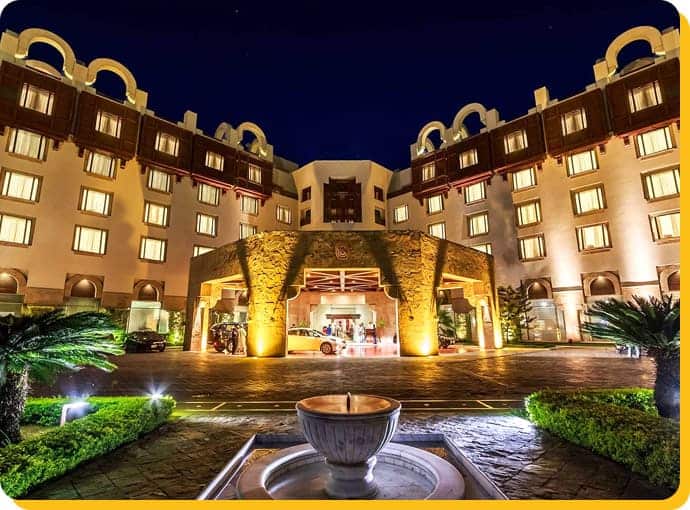 This trip is a 10-day trip to Pakistan starting from Islamabad. This tour was developed by our tour guide Atta (you can email him here), who works full-time as a tour guide in North Pakistan (more on Atta later).
Islamabad is the capital of Pakistan, but it is far from the largest city. Pakistan has a population of over 240 million, yet Islamabad has only about 1 million residents. This makes the city a peaceful place to stop and learn about the country. I recommend spending at least one full day exploring Islamabad, though spending two days is even better to help you recover from jet lag and see the sights at a relaxed pace.
Start your day with some of the best coffee in Islamabad at Mocca Cafe in Kohsar Market. While you are there, start your local shopping experience. I suggest buying one or two scarves here; you will need them when entering mosques or as a sign of respect for local culture in certain areas.
To buy beautiful parchment paper (actually from Nepal), head to the Maharaja handicrafts at Madrasa Road, F6 market. For Afghan handicrafts and antiques, check out the shops near Maharaja on Aga Khan Road, close to the flower shop.
If you want an unforgettable experience with Pakistani culture, architecture, and luxury, I highly recommend a stay at the Serena Hotel. It is considered the most beautiful hotel in Islamabad and offers every amenity you might need, including an outdoor pool, a fitness center, and a large restaurant with an excellent buffet breakfast.
Skardu: The Heart of Gilgit-Baltistan
An important note about this itinerary: much depends on the flight from Islamabad to Skardu which covers an aerial distance of approximately 320 km which offers breathtaking views of the Himalayas. Due to the high mountain passes, these flights are frequently cancelled. If you want to review all your travel alternatives beforehand check out our comprehensive guide on how to reach Skardu by both air and road. If you are travelling on a guided tour and your flight is cancelled, alternative road arrangements will be made for you. Navigating these logistics is much easier with professional help, so feel free to check out our Skardu Tour Packages for a stress-free experience.
If you are travelling solo, I suggest having a few days of flexibility in your schedule, as there is usually only one flight per day and it depends entirely on the weather.
Unfortunately, our journey began with a flight cancellation, which meant swapping a one-hour flight for a long-distance road trip. The total road distance from Islamabad to Skardu is approximately 635 km, a journey that takes about 12 to 14 hours via the most direct route, though it can take up to 20+ hours depending on the season and road conditions. While this forced us to adjust our route, we are sharing this itinerary as originally planned, with the hope that your travel goes smoothly.
However, if you are traveling during the summer (June to October), we highly recommend the scenic route through the Naran Kaghan Valley. There are so many incredible places to visit in Naran Kaghan, The distance from Islamabad to Naran is about 280 km (6-7 hours) and we suggest a one-night stay in Naran to break the journey. From there, it is a spectacular 65 km drive to reach Babusar Top (13,691 feet).
After crossing the pass and descending to Chilas, the remaining distance from Babusar Top to Skardu is roughly 290 km. This final leg joins the newly paved Jaglot-Skardu Road (JSR), where you will witness the junction of the world’s three greatest mountain ranges. Whether you hire a private 4×4 Jeep or a sedan, the final hours through the Indus River canyon are truly rewarding.
If you are traveling between November and May, the Babusar Pass is closed due to snow. During these months, the drive follows the main Karakoram Highway (KKH)—often called the eighth wonder of the world—via Besham, Dasu, and Chilas. This route stays open year-round and offers a rugged, dramatic journey alongside the Indus River.
Upon arrival, you’ll realize Skardu is truly the jumping-off point for expeditions to K2 and home to the stunning Shangrila Lake (Lower Kachura Lake) is just 25 km from Skardu city and the Manthoka Waterfall is about 80 km into the Kharmang Valley. Before you head out to explore the Sarfaranga Cold Desert (located 15 km from the main town).
Make sure to stock up on local dried apricots, walnuts, and almonds. In these remote areas, you might go 12 hours between meals during long travel days, so it is best to be prepared with these high-energy snacks!
1. K2: The King of Mountains
While you won’t see K2 from the Skardu city center, the town serves as the essential gateway for all expeditions to the world’s second-highest peak, towering at 8,611m (28,251 ft). Known as the “Savage Mountain,” it remains one of the most challenging climbs for mountaineers globally.
For many travelers, Skardu is the starting point of the legendary trek to K2 Base Camp. This journey begins with a rugged jeep drive to Askole, the “last village” before the wilderness. From there, trekkers traverse the massive 63km-long Baltoro Glacier to reach Concordia, often referred to as the “Throne Room of the Mountain Gods” because it offers a 360-degree view of four 8,000-meter peaks.
2. Shangrila Lake (Lower Kachura)
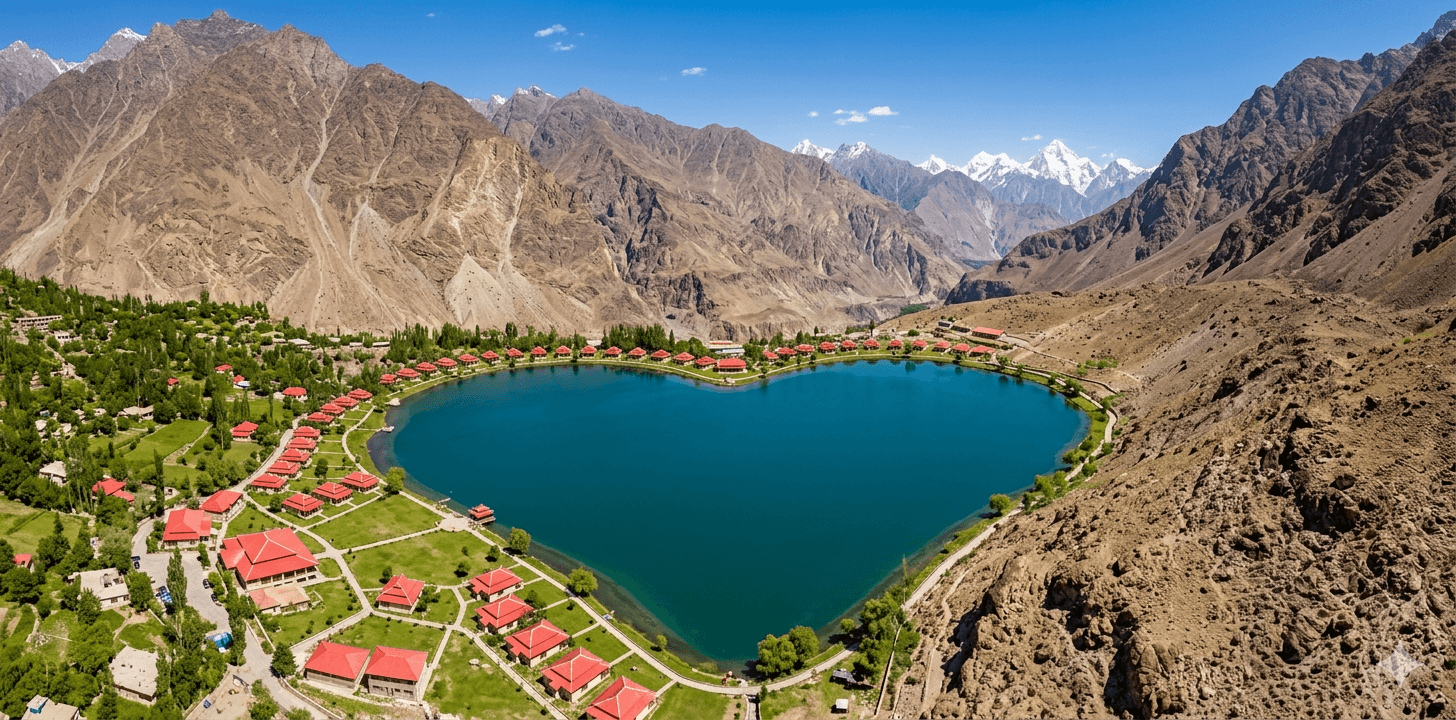 Often called “Heaven on Earth,” Shangrila Lake is famous for its iconic red-roofed resort and heart-shaped shoreline. Located about 20 minutes from Skardu city, it’s a perfect spot for boating and photography. Don’t forget to visit the famous airplane cafe—a unique restaurant built inside a grounded aircraft!
3. Manthoka Waterfall
Located in the Kharmang Valley, Manthoka Waterfall is a majestic 180-foot drop that offers a refreshing escape. It is a popular picnic spot for locals and tourists alike. The lush green surroundings and the mist from the falls make it one of the most picturesque locations in the Skardu region.
4. Sarfaranga Cold Desert
Known as one of the highest cold deserts in the world, the Sarfaranga Cold Desert features stunning white sand dunes framed by snow-capped mountains. If you’re visiting in the summer, you might catch the famous Sarfaranga Jeep Rally. It’s an ideal place for stargazing and thrill-seeking bike rides over the dunes.
Shigar Fort
A scenic 32 km drive from Skardu brings you to the historic Shigar Fort , a stunning 17th-century palace and historic site (also known as Fong Khar or the “Palace on the Rock”). While the distance is short, expect the journey to take about 45 minutes to 1 hour as you wind through the valley and breeze past the stunning white dunes of the Sarfaranga Desert.
It is now home to one of the most beautiful heritage boutique hotels in Northern Pakistan. Managed by Serena Hotels.
The experience here is incredibly authentic, the ancient architecture and surrounding mountains make you feel as if you have stepped onto a movie set. The village itself is a wonderful place to experience local Balti culture, whether you are wandering through the hustle and bustle during the day or simply relaxing after your journey.
As the gateway to the high peaks of the Karakoram, Shigar Valley offers some of the most serene landscapes in the region and serves as a vital hub for trekkers heading toward the mighty mountain ranges.
If your timing is right, you may be able to catch a local polo match nearby. Be sure to ask your guide or the locals for the latest schedule—polo is a legendary sport in Gilgit-Baltistan, famously known as the “Game of Kings.”
Khaplu Palace: A Living Heritage Experience
A scenic 113 km drive (approximately three hours) from Shigar brings you to Khaplu Palace. Also known as Yabgo Khar, this 19th-century royal residence is situated about 103 km east of Skardu city along the ancient trade route to Ladakh.
This is not just a stopover, it is one of the most beautiful heritage accommodations in Pakistan and a definitive highlight of any 10-day northern Pakistan itinerary. Managed by Serena Hotels, the palace has been masterfully restored to showcase its unique blend of Balti, Tibetan, and Ladakhi architecture. If your schedule allows, we highly recommend staying for more than one night to truly soak in the serene atmosphere and explore the nearby 700-year-old Chaqchan Mosque.
While staying here, be sure to take a guided tour of the palace. There is a wealth of history to discover about the Yabgo Dynasty, the architectural restoration by the Aga Khan Cultural Service Pakistan, and the unique culture of the surrounding Baltistan region.
For a truly royal experience, don’t miss the Royal Afternoon Tea. You can enjoy it on the traditional wooden balconies overlooking the lush palace grounds with unobstructed views of the Karakoram peaks. For a hidden gem, ask the staff politely if you can explore the rooftop. it offers a breathtaking 360-degree panoramic view of the entire Khaplu Valley.
If you are feeling energetic and adventurous hike up to Thoqsikhar, a viewpoint about two hours from the palace. You can ask the hotel to pack a picnic lunch for you to enjoy at the top or head out on a sunny morning and return to the palace for a relaxing lunch in the beautiful organic gardens.
On your day of departure, consider a short 20-minute stop in Bara before heading toward Gilgit. This small village is home to a famous wool textile center that trains and supports local women. It is the perfect place to purchase an authentic Baltistani Patti (wool fabric) or a traditional topi as a souvenir.
Gilgit: The Heart of the High Mountains
The total journey from Khaplu to Gilgit covers a massive road distance of approximately 310 km. Because this is a long-distance drive that takes around 7 to 8 hours, we highly recommend departing early if you want to reach Gilgit before dark. Alternatively, many travelers choose to return to Skardu city center (103 km from Khaplu) for a one-night stay in Skardu to rest up, grab supplies and break the long journey into two manageable segments before continuing the remaining 206 km from Skardu to Gilgit the next day.
Whichever strategy you choose, your drive along the newly reconstructed Jaglot-Skardu Road (S-1) will treat you to incredible sights. On your way, keep an eye out for the world-famous Junction Point of Three Mountain Ranges near Jaglot, where the Karakoram, Himalaya, and Hindu Kush ranges meet—a truly unique geographical marvel where the Indus and Gilgit Rivers also converge.
Gilgit is steeped in history, serving as a vital crossroads on the ancient Silk Road for centuries. Must-see historical sites include landmarks reflecting the region’s rich history and the Kargah Buddha—a magnificent, protected rock carving dating back to the 7th century located just 10 km outside the main city. These landmarks offer a unique glimpse into the region’s deep Buddhist and Islamic heritage.
If you have some extra time, a walk through the bustling Gilgit Bazaar is highly recommended. It’s a great place to find local handicrafts, woolen pashminas, and authentic Central Asian goods. For those with an extra day, Gilgit also serves as the ultimate gateway to the stunning Naltar Valley (about 40 km away), famous for its vibrant alpine lakes and winter ski resort.
During our stay, we opted for the Gilgit Serena Hotel, and it truly reinforced my admiration for their hospitality across Pakistan. The service is incredibly warm, making you feel right at home from the moment you arrive. A major highlight is the buffet-style breakfast, which is served in a dining area beautifully decorated to pay tribute to the local culture and the traditions of Central Asia.
Karimabad, Hunza Valley
The journey from Gilgit to Karimabad (the main hub of Hunza) covers a spectacular road distance of approximately 100 km along the smoothly paved Karakoram Highway. The drive takes about 2 to 2.5 hours and offers breathtaking roadside views of Mount Rakaposhi (7,788m). If you want to settle down in any place for a few days to rest, we strongly recommend choosing the Hunza Valley. Famous for its majestic peaks, unparalleled safety and an incredible 99% literacy rate, Hunza is widely considered the crown jewel of all the iconic places in the Northern Areas of Pakistan.
When you get hungry exploring the cobblestone streets of Karimabad make sure to visit the legendary Cafe de Hunza. Indulge in a slice of their world-famous walnut cake paired with a cold iced coffee latte. After days of drinking instant coffee on the road this real espresso kick will leave you completely refreshed!
Exploring Gulmit & Upper Hunza (Gojal)
While Karimabad has historic fortresses like Baltit and Altit. The Hunza region has many other vibrant towns to explore. Just a 30 km drive further north (about 45 minutes through the Attabad Lake tunnels) lies Gulmit. The historic capital of Upper Hunza (Gojal). Gulmit is famous for its progressive community and inspiring women’s empowerment initiatives. In fact, this is one of the few towns where you will see local women actively managing shops, cafes, and carpet-weaving centers.
To support this wonderful local community, you can buy exquisite, authentic souvenirs including organic apricot oils, local gemstones, hand-woven woolen shawls and traditional woodwork. Along the bazaar streets. You will find incredibly welcoming artisans and shop owners who speak fluent English, making shopping here one of the easiest and most memorable experiences in all of Pakistan.
Wandering in Northern Pakistan: Attabad Lake & Hussaini Bridge
Located just a short and scenic 26 km drive north of Karimabad (about 40 minutes via the Karakoram Highway). you will find the breathtaking Attabad Lake. The history of this stunning body of water is bittersweet, the lake emerged in 2010 after a massive landslide blocked the Hunza River creating a natural dam. Today, the lake collects icy, mineral-rich glacial silt from the surrounding Karakoram mountains, turning the water into a vibrant royal blue color during the spring and summer months. It is the perfect spot for jet-skiing or a relaxing boat ride.
Just 11 km further north from Attabad Lake lies the tiny village of Hussaini. The home to one of the most thrilling adventures in Northern Pakistan. This iconic, weathered walkway is the famous Hussaini Suspension Bridge—often nicknamed “The Indiana Jones Bridge.”
While it never actually appeared in the Hollywood movies the resemblance to a cinematic trap bridge is uncanny. Suspended high above the rushing Hunza River with massive, widely-spaced wooden planks that sway gently in the mountain breeze crossing it is an absolute adrenaline rush. It is totally worth a visit but it is definitely not for the faint-hearted!
 The Majestic Passu Cones & Sust Border Town
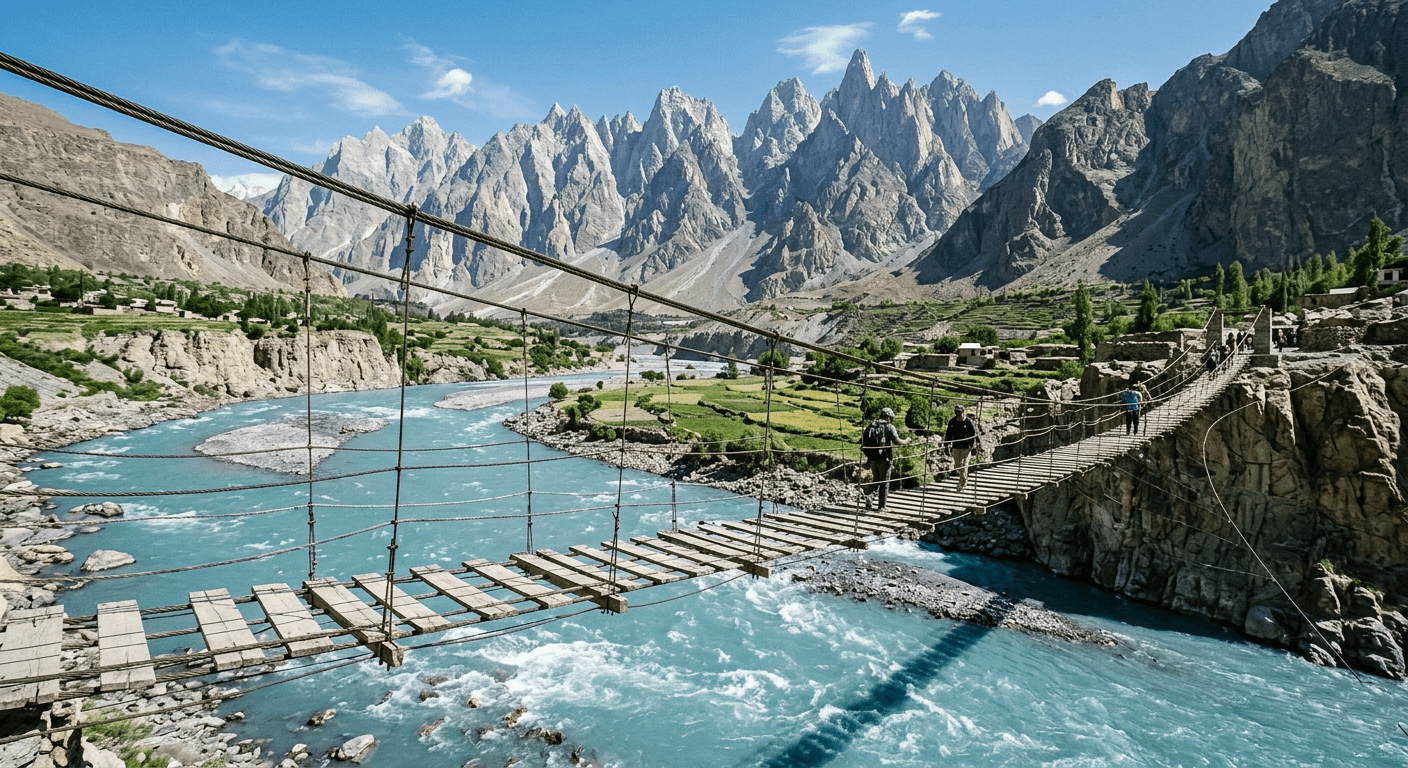
Driving just 8 km north from the Hussaini Suspension Bridge brings you face-to-face with one of the most photographed sights in all of Pakistan, the dramatic Passu Cones (also known as the Tupopdan Peaks rising to 6,106m). These jagged, needle-like granite peaks look like a row of giant stone cones piercing the sky.
While you are in Passu village make sure to stop by the local cafes to try their famous apricot cake and take a quick walk down to the viewpoint of the massive Passu Glacier, which creeps right down toward the Karakoram Highway.
Continuing 35 km further north along the highway (about a 45-minute drive) you will reach Sust (Sost). The final town in Pakistan before entering China. Sitting at an altitude of nearly 10,000 feet, Sust serves as the official dry port and immigration checkpoint for cross-border trade via the Khunjerab Pass.
The town has a unique, bustling energy filled with massive cargo trucks, customs officers, and traders. Wandering through the local market you will notice a fascinating mix of Pakistani, Chinese and Central Asian goods, making it the perfect final frontier stop to wrap up your unforgettable exploration of the Hunza Valley.
Fairy Meadows: The Gateway to Nanga Parbat
If adventure travel is what you crave, do not miss the thrill of visiting Fairy Meadows. The journey begins at the iconic Raikot Bridge (about 80 km south of Gilgit on the KKH). Where you must hire a local private 4×4 Jeep. From there, you will navigate one of the most famous, adrenaline-pumping dirt roads in the world, tracing narrow tracks along steep desert cliffs.
After a thrilling 1.5-hour drive, the jeep track ends at Tato Village. From Tato, it is a steady, scenic 2 to 3-hour uphill hike through lush pine forests to reach the breathtaking Fairy Meadows camping alpine lush pastures.
Fairy Meadows serves as the perfect base camp staging ground for trekking closer to Nanga Parbat (the world’s 9th highest mountain, standing at 8,126m). If you have the energy, we highly recommend hiking to the Beyal Camp or all the way to the Nanga Parbat Base Camp the next morning. While the full trek to base camp is challenging—requiring about 6 to 8 hours of round-trip walking—the views of the massive Killer Mountain glacier are life-changing.
Back at the meadows, the accommodation is surprisingly comfortable. The classic, Swiss-style wooden chalets at Fairy Meadows offer cozy rooms, and many lodges provide hot water and electricity during specific evening hours. Waking up here to watch the morning sun turn the snow-capped face of Nanga Parbat into gold is an unforgettable experience. If your itinerary allows definitely stay for at least two nights!
Karakoram Highway: The Eighth Wonder of the World
The legendary Karakoram Highway (KKH) is universally considered to be one of the greatest engineering achievements of the 20th century. Stretching across a massive 1,300 km (805 miles) to connect Pakistan with China. This ribbon of asphalt cuts through the most formidable terrain on earth serving as the ultimate spine of tourism in Northern Pakistan.
The ultimate destination on this highway is the Khunjerab Pass located just 85 km north of Sust. Sitting at an incredible altitude of 4,693 meters (15,397 feet), it is the highest paved international border crossing in the world and features a striking monument marking the frontier between the two nations.
However, you don’t need to drive the entire distance to experience its epic magic. Simply traveling the loops through Hunza and Baltistan will take you through thrilling hairpin turns, past massive, rolling mountains and into welcoming alpine villages.
As you pass through, you will see local children playing and elders waving—reminding you that the warmth of the people along the KKH is just as unforgettable as the towering peaks above them.
For roaming around the country, you are probably going to need these essential travel tips and hacks to keep your journey stress-free. Along with planning your path, don’t forget to look over our ultimate packing checklist for visiting Northern Pakistan to ensure you bring the right layers for changing mountain temperatures:
Travel Tips & Hacks: Navigating Flights and Luggage
When you are planning your adventure to Northern Pakistan, how you book your flights can make or break your trip. Here are some essential tips and hacks to ensure your journey goes as smoothly as possible:
Prioritize Direct Flights Whenever Possible
When booking your flights to Pakistan or your domestic connections from Islamabad to Skardu/Gilgit, try your best to book direct. Choosing flights with multiple connecting stops opens the door for a lot of logistical headaches. Every extra connection means more opportunities for flight delays, schedule changes, and missed departures.
More importantly, extra flight connections mean your suitcases are loaded and unloaded multiple times. This drastically increases the chances of your luggage being delayed, lost, or damaged. God forbid you arrive in Islamabad or Skardu ready for a mountain trek, but your luggage fails to arrive with you!
Protect Your Sleep and Energy
Flight connections will also heavily interrupt your sleep cycle. If you are the kind of traveler who needs solid rest during long-distance transit, there is nothing more painful than being woken up mid-flight, forced to disembark, navigate a busy transit airport, and search for a new departure gate while completely exhausted.
If a connecting flight cannot be avoided, **make sure you do not cut the layover time too short**. Always ensure you have at least a 2 to 3-hour buffer window between flights. This gives you a safety net in case your first flight faces a minor delay and ensures you don’t have to sprint across the terminal to catch your next connection.
Communication is the Key: Staying Connected in the Mountains
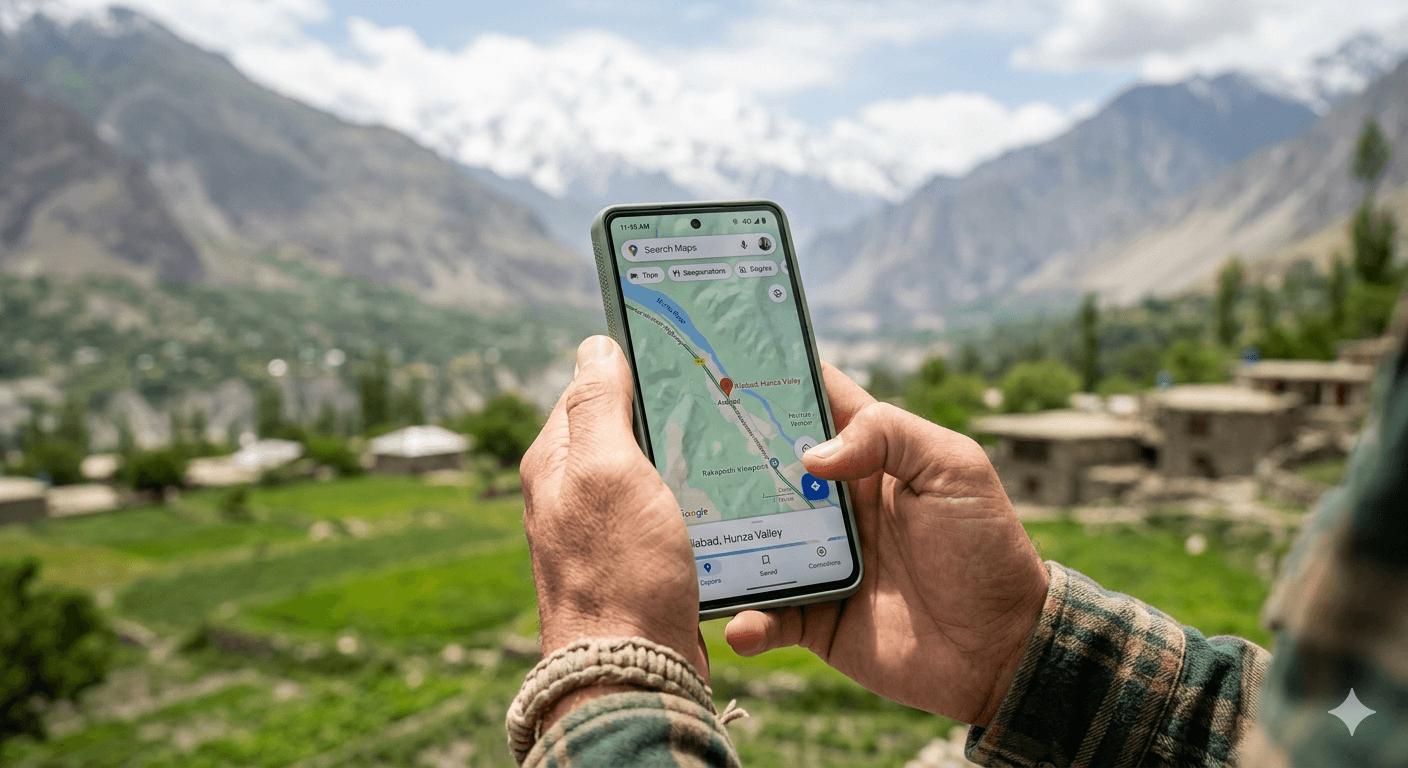 When traveling through the remote valleys of Northern Pakistan, staying in touch with your driver, hotels, or family back home requires some forward planning. Standard mainstream mobile networks like Jazz, Telenor, or Zong often lose signals completely once you deep-dive into the mountain passes.
The ultimate hack here is to purchase an SCOM SIM card as soon as you arrive in Gilgit or Skardu. SCOM is the primary telecom network operating in Gilgit-Baltistan and Azad Kashmir, offering the most reliable 3G/4G data and calling network even in remote areas like Hunza or Khaplu. You will need your original passport or CNIC to register the SIM at an official customer care center.
Language and Local Interactions
Beyond cell reception, human communication is incredibly smooth here. While the local languages vary—ranging from Balti in Skardu to Shina in Gilgit and Burushaski in Hunza—you will find that a surprising number of locals, especially shop owners and younger guides, speak excellent English. Learning a few basic Urdu phrases like “Assalam-u-Alaikum” (Peace be upon you) or “Shukriya” (Thank you) goes a long way in showing respect and unlocking the legendary hospitality of the region.
Useful Websites and Apps for Trip Planning
Planning a journey through rugged mountain terrain requires the right digital tools. Various websites and applications make it easy to create itineraries track your bookings and share your travel plans with friends and family. Here are some of our favorite apps to keep your trip organized:
- TripIt.com:
This is an incredible tool for creating complex travel routes. All you need to do is forward your hotel, flight, and car rental confirmation emails to the app, and it automatically builds a master itinerary for you. It seamlessly integrates maps, driving directions, and local weather updates. The core version is completely free, though they offer a paid pro tier for real-time flight delay alerts. - TripCase.com:
Very similar to TripIt, this app helps you manage your daily schedule in a neat, chronological timeline. You can effortlessly share your live itinerary with family back home so they always know which valley or hotel you are in, and you can manually add custom stops like local restaurants or shops along the Karakoram Highway. - TripHobo.com:
Instead of just organizing bookings, TripHobo helps you discover what to do. You enter your start and end points, and the platform suggests popular activities, sightseeing spots, and user-generated travel routes to give you inspiration for your daily sightseeing.
Essential Apps Specifically for Pakistan Travel
While the global apps above are fantastic for organizing your paperwork, navigating on the ground in Northern Pakistan requires a few local lifelines:
- Maps.me (Offline Maps): Because mobile internet can drop unexpectedly in deep valleys like Swat, Hunza, or Skardu, download Maps.me before you leave. Download the offline map files for Northern Pakistan so you can track your GPS location, find hiking trails, and locate guesthouses even with zero mobile signals.
- Indrive / Yango: While you will need private 4×4 Jeeps for places like Fairy Meadows or Deosai, these ride-hailing apps are incredibly useful, budget-friendly, and safe for moving around main transit cities like Islamabad or Gilgit.
Final Words: Embrace the Adventure
The most important thing to remember is that your travel itinerary is not a legally binding contract. Think of it more like a beautifully crafted draft written in the sand. When traveling through the rugged terrains of Northern Pakistan, things will occasionally change—a mountain road might be temporarily closed due to weather, a local restaurant might keep unexpected hours or a herd of yaks might block the highway.
We highly recommend leaving at least one or two flexible “buffer days” in your travel plans. As you explore, you will undoubtedly discover hidden viewpoints, local festivals or charming villages that you didn’t even know existed before you set off. Having a flexible schedule gives you the leeway to enjoy these unexpected treasures without feeling rushed.
Generally speaking, the more adaptable your mindset and travel paths are the better your experience will be. When you anticipate minor bumps on the road, you can easily navigate around them with a smile. If you balance flexibility with smart planning, you can easily design the perfect itinerary for your trip.
Designing seamless and efficient itineraries requires a balance of realistic logistics and a passion for discovery. A well-structured travel plan is the backbone of any successful tour. At See Pakistan Tours we warmly encourage you to take the leap and plan your visit to Northern Pakistan—an absolutely unforgettable and life-changing experience is waiting for you!
To make things easy, you can explore our pre-made itinerary plans like our signature Hunza Valley packages, breathtaking Skardu tours or scenic Swat Valley tour packages.
Ready to start planning your custom adventure? You can get a quote from our expert travel team today or simply send a WhatsApp message or call us at +92 310 5436581 for an immediate, quick response!
Frequently Asked Questions (FAQs)
1. Is it safe to travel to Gilgit-Baltistan and Northern Pakistan?
Yes, Gilgit-Baltistan (including Hunza, Skardu, and Shigar) is widely recognized as one of the safest regions in Pakistan and South Asia. The local communities are incredibly welcoming, crime rates are remarkably low, and hospitality is a central part of the culture. It is highly suitable for group tours, families, and solo female travelers alike.
2. Which mobile SIM network has the best coverage in Hunza and Skardu?
SCOM is the primary and most reliable mobile network across Gilgit-Baltistan, offering the best 3G/4G coverage in remote valleys. While national networks like Zong 4G and Telenor work well inside main city hubs (such as central Skardu and Gilgit city), their signals drop rapidly once you drive into deep mountain passes. Traveling with a dual-SIM phone using both SCOM and a national carrier is highly recommended.
3. What should I pack for a 10-day trip to Northern Pakistan?
The weather in the mountains can change rapidly. You should pack versatile layers, including lightweight cotton clothes for daytime transit, a warm fleece or down jacket for cold alpine evenings (especially at Fairy Meadows), comfortable hiking shoes and sunscreen. Foreign and domestic travelers should also pack a scarf out of respect when visiting local cultural sites or mosques. For a complete list, review our comprehensive packing checklist for Northern Pakistan.
4. What happens if my domestic flight from Islamabad to Skardu or Gilgit gets canceled?
Flights to Skardu and Gilgit depend entirely on clear mountain weather and mountain pass visibility. Cancellations happen frequently. If your flight is canceled the standard backup option is to travel by road via the Karakoram Highway (KKH) or through the Naran Kaghan Valley (during summer). Traveling with an experienced agency like See Pakistan Tours ensures that backup private transport is arranged instantly without you having to scramble for logistics.
5. Do I need cash, or are credit cards widely accepted in the northern areas?
Northern Pakistan runs primarily on a cash economy. While luxury heritage accommodations like the Serena Hotels accept international credit cards, local bazaars, jeep drivers, guesthouses and restaurants do not. Make sure to withdraw sufficient Pakistani Rupees (PKR) at ATMs in Islamabad, Gilgit city or Skardu city before heading deep into remote locations like Passu, Khaplu, or Fairy Meadows.